AI
General
2026 AI ROI Hypothesis
Jan 9, 2026

2025 was a fascinating year for AI.
Every week, a new model shattered a benchmark, and Agentic AI became the word on everyone’s lips. On paper, we were living in the future. But when I stepped away from the screen, I noticed a disconnect. In the real world, at the gym, the grocery store, or even in the daily workflows of my friends, nothing had changed.
I spent the year testing small and large models, obsessing over prompt guides, and diving into product and policy through my coursework. The feedback was consistent: For most, AI felt like an added step, often yielding a bad output that required more work to fix than to do from scratch.
I started asking myself: With billions in investment pouring in, why is the average person still standing on the sidelines?
The Paradox of More
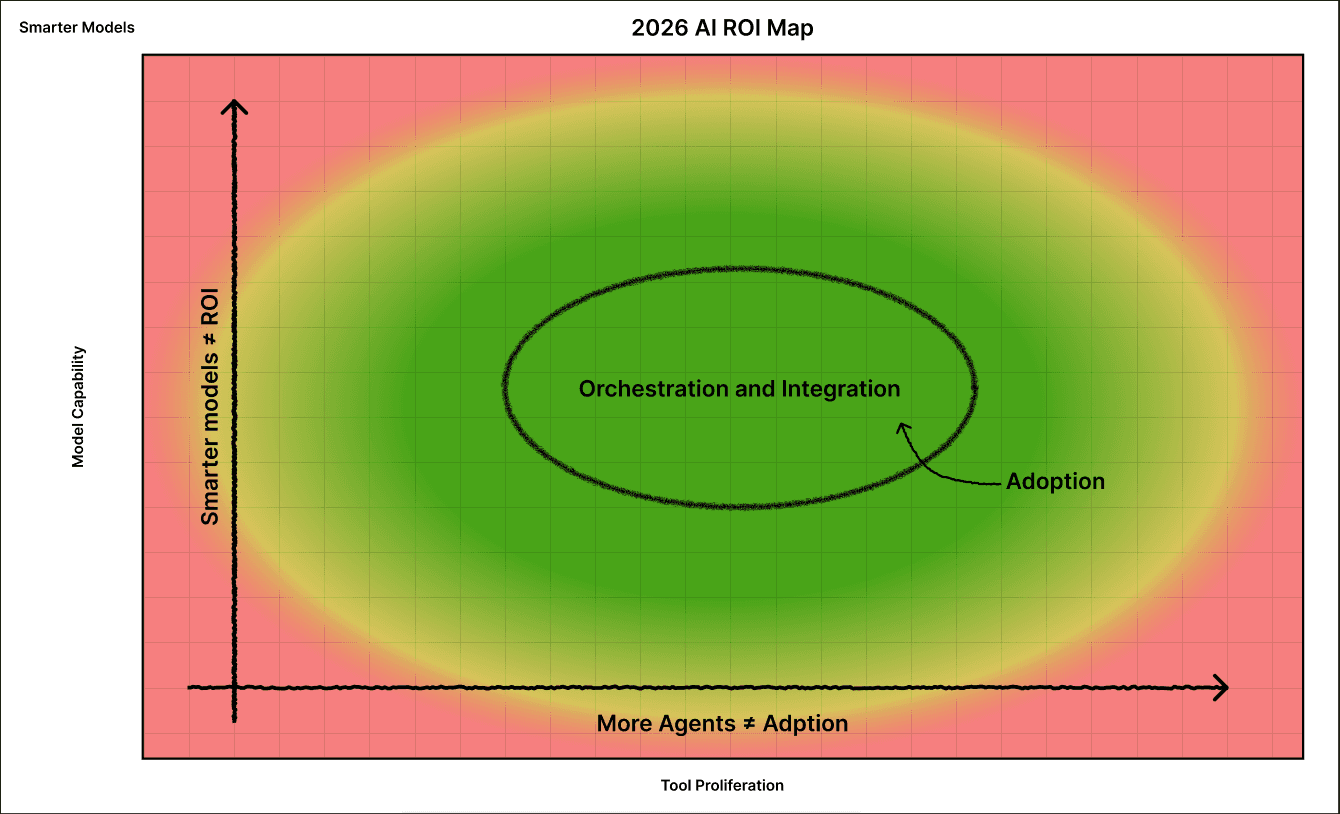
My hypothesis for 2026 is that we are approaching the limit of what more can do for us.
Google, OpenAI, and Anthropic will continue to build smarter models. Startups will continue to flood the market with specialized agents. But if we continue down this path, we aren't building a solution; we’re building a complexity trap. Think of it like the early days of electricity. In the beginning, if you wanted power, you had to own a generator. You had to be a mechanic just to keep the lights on. That is where we are with AI today, we have incredible power plants, but everyone is still responsible for their own wiring.
Smarter models do not equal ROI if they require a PhD to operate. More agents do not equal adoption if they create more siloes.
The Blue Ocean Opportunity: Orchestration & Integration
The real innovation of 2026 won't be a 10% faster model or a 100th specialized agent. The Blue Ocean, the wide-open, uncontested opportunity is Orchestration. Orchestration is the Light Switch moment for AI. It’s the invisible layer that:
Dissolves the Siloes: Instead of a "system of systems" that confuses the user, it creates a single, fluid experience where data moves and tools talk to each other.
Focuses on Intent, Not Instructions: It moves the burden of prompting away from the human and puts the burden of execution on the system.
Makes AI Accessible to the Average Joe: It brings the power of frontier models to the local gym, the small business, and the enterprise worker without them ever needing to see a terminal or a prompt box.
The Future is Harmonious
I am incredibly hopeful for 2026. We are moving out of the era of tinkering and into the era of utility. The companies that will win the next few years won't be those that build the loudest AI, but those that build the most integrated AI. We don't need more tools; we need more harmony. We need to stop building smarter engines and start building the Grid that lets the whole world finally flip the switch.